A look into the musical world of Trevor Rabin: composer, performer, and a man of many careers.
Introduction:
A series of essays wherein I explore the numerous musical identities of my favorite musician: from child prodigy to teen idol to guitar hero to singer/songwriter to award-winning in-demand film composer.
Featuring news/updates and commentary/analysis of Trevor's career and associated projects. Comments are disabled but please feel free to contact me at rabinesque.blog@gmail.com.
This week Washburn put together a new endorsement ad of sorts for Trevor's signature model, and here is the image (courtesy of their Facebook page):
I apologize for the previous confusion on my part as there are two versions, one American and one for the rest of the world, and the model numbers reflect that difference. And I understand the use of that particular photo as it shows off the body of the guitar nicely, but I'm more partial to this shot and the Maestro's grin which is always a pleasure to view.
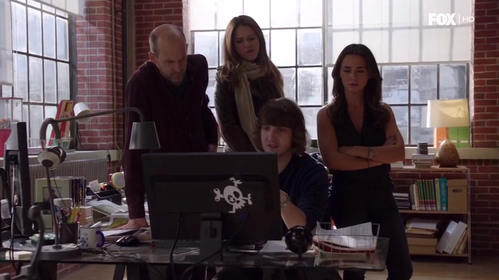
(Author's note: this essay contains spoilers for the tenth episode of Zero Hour, so don't say I didn't warn you!) Yes it's back! (sort of)... I'd like to thank all those far and wide who have read these recaps and (hopefully) enjoyed them, as they have received much traffic on the blog. I do plan to finish the series, but it takes a lot of time and effort to write these, as anyone who recaps movies and TV shows online (either in website. blog, or podcast form) can attest. The Knowing The Score series is fun to do, just slow to be posted, is all. But I truly appreciate your interest as always.
Previously on: COUNTDOWN TO ARMAGEDDON, APPARENTLY. So the Faroe Islands isn't necessarily the best of vacation destinations if you're looking for the True Cross. Plus, a random road sign tried to kill Hank. Harsh! And the Shepherds make a mean kaleidoscope. Nine is the number of judgment the measure of our soul. When all secrets come to light the truth shall take its toll. Well duh!, Vincent! That's pretty much the whole premise of this show, right? In the year of Der Fuhrer, 1937: Sterm is asked to participate in Project Zero Hour. Take a drink for the Godwin-citing inclusions of the phrase "Perfect German" and the playing of Wagner. Sterm and Dietrich find themselves attempting to utilize irony as they donate their blood for the cause. But is there juice and cookies? Back on the island, the Unholy Trinity is being held at gunpoint while the Pyrate minions collect the True Cross-munching beetles, and as Riley is all FEELINGS OH GOD NO WHY?! at Molars, he is as cold as the North Sea...but no, wait, he says he'll shoot them, but he totally doesn't. It's the old bait-and-switch while Riley cries, "You remember who we were, I can see it in your eyes!" "I remember," Molars replies. He warns her not to follow him, oh yeah, like that's gonna work. Later, as they're all warm and safe in some waystation, Laila realizes her fear was misguided, and Jacinda has a moment of slippage where her normal speaking voice comes through, although I understand it could have been played deliberately. Because Riley is the worst listener ever, she's going after Molars. She makes a reference to her and Hank being alike in their predicaments, but she is still trapped in her delusion. Back on the ship, Molars is science-ing, WV shows up with his usual obnoxious flirting, and Molars shoots him down with the observation that "you're just a hired gun, and you're about two days away from getting your pink slip." He has to invoke Mommy Locust to put an end to the pissing match. Hank and Laila are on conference call with the Cute Squad, who regretfully inform him Hank's dad went off with the Pied Piper of the Apocalypse, aka Mommy Locust. Oh crap! Ever helpful, Laila states the obvious about it not being over after all. We flashback to A Moment of Destiny in 1963, where Hank's dad is being headhunted for Project Zero Hour due to his "unusual interests" in molecular biology. The recruiter is, of course, Melanie's father. Hank's dad is all, "Yeah but, Albania," and Melanie's dad says, "But we'll let you do your crazy secret experiments!" In cross-cut to the present day, Hank's dad is in the possession of a file cache inscribed with an ouroboros, and being told that he is the only one who can finish the project. I realize now there's a difference between when the title sequence starts online as opposed to broadcast television. I watched this episode on TV and it was at five minutes, which is probably the norm. So online the sequence starts at eleven minutes and that just feels too long. It's interesting how ingrained these little things are in regards to viewer reaction. Meanwhile, somewhere in the North Sea, mutiny is a-brewing as the crew wonders what is going on with all the hazmat stuff, and gives WV an ultimatum. Guys, that's so not the right decision, sorry to say. WV calls Mommy Locust who tells him to clean it up. Hank and Laila manage to track down Roland, who stonewalls them with all kinds of obfuscation and gruff retort, the kind that historically silly fools employ when they believe they've got a handle on the situation. I also get now that Arron is meant to be the metaesque commentator on the narrative superstructure and what-have-you as he tells Hank, "This is insane...why is everyone in your life hiding some secret from you?" Good question, dude, but uh...that's it, that's the show right there, as they say in memeland. The Scoobies split up with the respective research assignments as Hank and Laila visit the Galliston homestead. Hank wants to find his mom and so they begin searching for clues again, and Laila is having FEELINGS, nostalgic for their lies-all-lies fake marriage and Hank makes it clear that he forgave but he didn't forget being married to the Lying Liar Who Lies. Remembering that Roland was nifty with code as well, between the two of them they figure out the puzzle of where Rose ran off to, as Hank finds a book with a hollowed-out hiding place containing a gun and a cellphone. Somewhere in the North Sea an insertion team is boarding what is now a ghost ship: the entire crew is dead, but White Vincent and Molars are gone. It's noted by a member of the team that once again Riley's obsession is putting others at risk. Gee, ya think? Hank and Laila show up at the safe house where Roland and Rose had been hiding. Mom is rather frazzled - she keeps wanting to make tea - and Hank finally gets her to focus enough to start Expositioning Or Else. Rose relates the story of Project Zero Hour, she and Roland met while working for The 41 Trust in Albania, Roland was your typical arrogant doctor, Closer To God than anyone else. He actually says, "I have a moral obligation to the future of science." SCIENCE! And because it's 1968, he can fully enact his white male privilege by responding to her opinion of his work, "Don't condescend, a clever nurse is still a nurse." (Oh wait a minute, doctors are still saying that today...never mind.) Their dialog is a bit anachronistic, however, even with the proper cultural orientation, but we are given a first glimpse of poor old WV, already outcast as a failure of the project. Rose reveals to Hank that, yes, he is the first successful lab rat, er, gestational cloning of a human being. Understandably, Hank freaks out. Laila stops lying long enough to be supportive in an appropriate fashion. Rose discusses his birth, and in flashback we see he is perfectly normal, but still just Subject 352 in the overall scheme of things. Roland and Rose, realizing this perfect baby will be dissected to discover why the process finally worked, plot to rescue him from his lab rat future and disappear into the world at large, forever hiding from the greater agenda of The 41 Trust. Mom tells Hank he's got to run and never look back, but Hank gets all Quixotic and declares he's going to rescue the only dad he ever knew. D'awwww....kinda has a nice symmetry to it, non? Meanwhile, the Cute Squad has their research-fu going on and Girl Genius has an epiphany, as you do when you're a genius. The investigation aboard the ghost ship reveals the crew was deliberately gassed, there is no actual hazmat contamination, the use of the canisters and so forth was just a ruse to keep them from being too curious about the cargo. Looking through the lanyards left behind, we see ID for both WV and Molars, and cut to some other facility where the two are in a ultraviolet-lighted lab, WV is, in his passive-aggressive petulant way, demanding answers. Mommy Locust informs him he is a failed experiment but won't reveal the plan, and he tries wheedling to be allowed to remain. He's never really grown-up, poor White Vincent.
Roland is taken to the Lab of Villainy as Mommy Locust knows he is close to discovering the correct sequence so that the plot device, er, Final Solution or, you know, whatever, can move forward. He manages to get a message to Rose that he's being moved. Hank breaks the news of his lab rat origins to the Cute Squad and they are, understandably, freaked out. That's gotta fuck with your head, am I right? They theorize about WHY someone would want to clone humans, way back when, and Arron lets them in on the significance of the bugs which were found having chowed down on the True Cross in the Faroe Islands, the Death Watch beetle. The Shepherds hid the Cross when they discovered the Nazis were trying to clone humans because they wanted to do so using the blood of Christ.
And then we are granted the sight of His Holy DNA spiraling upon a computer screen in the Lab of Villainy. Hank and Laila have a martial-type spat regarding Hank's plan to rescue his not-dad. She insists, "You know you once said to me that you would do anything if I asked," reminding him - and us - that she is still a Hot Girl even if she's not utilizing any particular fu at this time. Sensibly, Hank points out that no matter where they would run to, they would be pursued. But I think it's too late for the beautiful one (Laila is aptly-named) and his FEELINGS! for her. Meanwhile, the Lab of Villainy and discussion of The Final Solution, er, plan. Mommy Locust announces the return of noted scientist Roland Galliston, however she doesn't believe his explanation for his interestingly-timed appearance and WV gets all thuggish, sensing he can at least step back into his old role as the enforcer once more. Riley shows up at the Media Empire with one of the hazmat canisters and she's still under the impression that Molars was once her husband rather than a Deep Cover Lying Liar Who Lies, but she's figured out that the canister points to the agenda of The 41 Trust and the Scoobies enact their research-fu once more. Hank's dad is stalling again and is visited by WV who confronts him, revealing that he remembers who Roland is, and his part in WV's continued existence (which he may or may not be grateful for). Riley asks where Laila is, and we see she has gone out for forged identification and documentation for herself and Hank, still hoping she can convince him to disappear with her. But really, she should know that her Skeptical Schlub is on a Mission from The God He Doesn't Believe In to try and save his not-dad. Because he's the good guy. Back at the Lab of Villainy, WV plays host for Roland's This Is Your Life as we see via flashback how the rescue operation came to pass, but not without sacrifice. Knowing that WV's freaky-ass sclera is going to give the whole game away, there is an incredibly sad scene where he is delivered to the orphanage from the past flashbacks (it's dark and snowing, what is this, Dickens?) and we understand why WV has referred to Hank as "brother" whenever they've met. Hank's blood is what they want, that's what makes him the device. To quote any number of vampires, the Blood is the Life (they seek to recreate). Hank makes a connection with one of the Modern Skeptic magazine covers (See, the Media Empire is relevant to our interests!) and leaves Laila a message saying he thinks he knows where to find Roland. He goes out to a certain spot by the harbor and is nastily ambushed by WV, who apparently doesn't truly apprehend the meaning of "brotherly love." Now to the good (scoring) stuff: again there are lots of great action cues in this episode given all the crosscutting scenes and so forth, but what really caught my ear was an interesting ambient cue, although I wonder if it was one of Paul's.
(Imagine me saying that just like James May does on Top Gear...except this has nothing to do with the Dacia Sandero.)
The Maestro has been positively chatty on Facebook of late and today brings this update:
Even with the note of cautious optimism it is excellent news for all of us...especially those who have been wanting a new vocal album lo these past decades. In a later comment Trevor confirmed that "...this next album is more in line with Can't look away/Talk/90125 etc" which means he's ready to rock...oh yeah! And hopefully that also means we'll get to hear plenty of the new Washburn as well as the voice we love. Here's to a new year with new music and yet another reason to be thankful of Trevor's continuing artistry.
"I'd much rather have written it than not," - Trevor Rabin on "Owner of a Lonely Heart" from a 2003 interview
Recently Trevor shared a link to this YouTube video on his official Facebook page, featuring the popular Bluegrass family ensemble The Cleverly's performing (a little bit of) "Owner of a Lonely Heart." As Trevor is a fan of bluegrass music I imagine he was charmed by this particular appropriation, especially as The Cleverly's are a funny bunch of guys in addition to their obvious musical talents.
One of the true tests of time for a song is how well it can be translated to other genres/arrangements, and the million-dollar riff sounds as compelling on mandolin as Trevor's famous Strat. And in other genre crossovers, "Weird Al" Yankovic included "Owner" in one of his infamous polka medleys (and you know you've arrived when you've been parodied by "Weird Al"). But I'll save discussion of the other cover versions of the song for another entry.
Another measure of longevity is cultural relevance, and among its many citations, "Owner" has also become a frequently-sampled song in popular music recordings, with over 20 specific inclusions in hip-hop tracks alone. As "Owner" is a song which also utilizes sampling in its construction, this chain of appropriation is a fitting tribute to not only the history of collage methodology but the enduring power of pop culture as a whole. In regards to its own sampling provenance, it's been popularly cited that Questlove of The Roots - musician and journalist among his many talents - has declared "Owner" was the first song to use a sample as a breakbeat rather than a sound effect, and thus a further evolution of the use of sampling in musical collage construction.
One of the more recent samplings of "Owner" was in indie darling Gotye's track "A Distinctive Sound" from the album Like Drawing Blood, which actually reminds me of The Art of Noise (it's rather appropriate when you consider "Owner"'s pedigree).
It is also a calling card which has allowed Trevor to experience further opportunities in regards to his discography. As example, Michael Jackson desired Trevor to perform on the HIStory album because he was a fan of "Owner," which is sampled in the song "D.S." from that same recording, and Trevor appears on the song "They Don't Care About Us." I'll share an anecdote I was told about this session (the source shall remain nameless) but I thought - if it's true - it's a good example of Trevor's sense of humor. When Trevor showed up for the session at The Hit Factory - just him and the Strat - he ran a bit afoul of MJ's security team who weren't willing to take his word in regards to who he was or why he was there. In frustration Trevor finally proclaimed, "I'm Trevor Rabin, I am an African-American, and I'm playing this session!" And as the saying goes...he ain't never lied about that!
A specific value the song's iconic popularity has for me personally is if I invoke it with those for whom Trevor is not a familiar name, it acts as instant clarification. All I have to say is, "He wrote 'Owner of a Lonely Heart'" and the figurative lightbulb switches on. Sure, cultural immortality is potentially something to desire, but recognition in the here and now is pretty darn nifty too.
“Love the guitar VERY VERY much. It feels very organic, like i've played it for years. I'm in the saddle with it. Genuinely love it.”
This week Washburn has officially listed Trevor's signature model for purchase, stating it will be available as of April, although there appears to be a slight change in the model number, it is now the PXMTR20.
http://www.washburn.com/products/electric/PXMTR20.html
In 2012 Trevor participated in the Brand South Africa campaign, his interview reel can be viewed here:
He has also been included among South Africans of note on the nation's official tourism site, southafrica.net, for their Meet South Africa campaign in the "Best of South Africa" section along with such luminaries as Archbishop Desmond Tutu, actress Charlize Theron, authors Alan Paton, JM Coetzee and Nadine Gordimer, and politician Helen Suzman, whom Trevor paid tribute to on his site upon her passing in 2009.
The article on Trevor at southafrica.net can be found here:
Author’s Note: Some time ago I read a review/historical commentary piece regarding Rabbitt’s
second album which I felt rather missed the point, repeatedly, in regards to
cultural criticism and thus I was further inspired to share my own essay which I have been working on for several years now. So without further
ado…
A Boy and his Strat: Trevor’s teen idol cheesecake moment for the cover of A Croak & A Grunt in the Night.
In this blog you will read (if you so choose) many words in
praise of the Lekker Four, as I call them, and the reason why is best summed up
in this blurb from RetroFresh, the South African-based imprint which reissued Rabbitt’s full-length studio albums a number of years ago:
Three decades ago,
Rabbitt ruled South Africa for five short years: they were dazzling on stage,
innovative in the recording studio and a media phenomenon in the press.
In my interview with Trevor – in regards to the
auspices of his career in South Africa – he was very careful to make a
distinction between his role in Rabbitt and his efforts towards other genres
and forms which he was concurrently engaged in:
As far as seriousness
goes playing jazz was purely about the music and had nothing to do with any
marketing strategy or genres, unlike Rabbitt where marketing and packaging were
part of the business.
As an unabashed fan of Rabbitt – the Johannesburg-based group
which Trevor co-founded while still in his teens and which he single-mindedly
propelled to nationwide stardom in the mid-1970s – I have spent a great deal of
time in consideration of their time and place in cultural history, especially
because they inhabited such a strange little bubble, thanks to the isolationist
position granted to South Africa as a result of the practice of apartheid. Within their own fairly brief tenure as the
Best Band in the Land it seems their evolution was sped up, in that I firmly
believe when you compare their two full-length releases – Boys Will Be Boys! (1975) and A
Croak & A Grunt in the Night (1977) – it’s almost as if they were recorded
by two different bands.
And really, it’s not such a farfetched consideration. But more interesting, perhaps, is to
speculate how and why Rabbitt took that overwhelming consensus and used it as a
way to attempt to move beyond the popularity afforded in their home country and
aim for worldwide recognition. Had they
not the edicts against South Africa to battle – as well as internal strife -
who knows what they would have achieved.
But chronicling regarding Trevor’s career involves a lot of what ifs.
Running counter to some past commentary, Rabbitt had a
definite agenda in regards to how they would break big in the nation. Their manager Mike Fuller has admitted that
local girls were encouraged (read: paid) to help build a buzz by fervently screaming
during their sets at Take It Easy, the club in Johannesburg where the band had
a residency circa 1974-75. This practice
caught on for real rather quickly and resulted in the same type of behavior
which doomed the Beatles in regards to live performance. Trevor noted in a 1991 interview that the
audience reaction was a kind of “euphoria…hysteria” wherein the music could not
actually be heard over the screaming.
But touring was necessary in regards to continuing to build upon and
reward the fanbase and so the band did tour regularly right up to the time when
they had planned to travel to the United States. This, of course, never occurred.
But they certainly had created the best product to promote
in the form of their second release, which appealed – much as Trevor himself – on
several different levels, and a serious consideration of the album is long
overdue.
The band knew the stakes were high in regards to their sophomore effort, and this is reflected in
their preparation, as Doug Gordon notes in his article “Working For The People:
The Rabbitt Story:”
The 17 tracks laid down in its
plush new Main Street studio measured up to the standards in Europe and allowed
Trevor to push the creative limits. He worked with Duncan to reshape his songs
the Rabbitt way. Neil analyzed Nigel Olssen’s drumming on Elton John’s
top-selling Goodbye Yellow Brick Roaddouble album and added it to his
own technique.
Although any SA-based band could readily cop the conventions
of others half a world away, Rabbitt was one of the few bands who could take
various influences and build upon them to create a unique signature and
appeal. In a country with an incredibly
circumscribed media presence – subject to government censoring at any time – they
were the kind of larger-than-life figures both music and image-wise which their
target audience had longed for, and every aspect of the recording – from music and performances to arrangement to production to album
artwork to promotion – reflected this fact.
With the perspective of time this album is now as viewed Rabbitt's magnum
opus, but not merely because they never recorded another full-length release as a foursome. Their ambition, taste,
and musical intelligence was bound to provide a grander scale which then
supported the whole of their experience and ability in the creation of the
recording.
There are certain subjects and forms which inform Trevor’s
compositional aims in that timeframe (and thus are reflected on this album),
and Trevor has acknowledged that he experienced an introspective period in his
adolescence which led to lyrics addressing the world in which he lived, and for
which he longed to see made whole, as well as seeking those situations/influences
beyond his middle-class existence (having noted in a recent interview that he
often frequented the shebeens – illegal bars in Soweto – both to listen to
music and flout the law in playing onstage with black musicians). Beyond the writing of “(Wake Up!) State Of
Fear” during his tenure in Freedom’s Children in 1972, there were other songs
which expressed the frustration and yearning of living in a nation in the
shadow of apartheid and one of these which appears on the album is an accomplished piece of social
commentary. Another song crossed both
the color line and the boundary of what would be considered acceptable material
for a popular album in its inclusion.
And it’s to the credit of both the band and their production team that
they took those challenges straight on, they didn’t back down in
the face of possible criticism and controversy.
Certainly their enormous popularity – unprecedented for its time –
granted them a Teflon-like veneer in regard to whatever they did.
What is important to consider in regards to Croak is not that it is merely good music in a larger historical
context, but that it is one of the best recordings to ever come out of the
South African music scene in the Apartheid era as well as a historical document
which conclusively illustrates the inherent talent of Trevor Rabin long before
the world would know of him as the wunderkind and creator of the Million Dollar
Riff, courtesy of a song which endures because at its core it transcends
considerations of history, genre, and trends.
So those opinions which are likely to express such sentiments as
“Rabbitt were actually a good band despite their teenybopper image,” are
extremely reductionist, in my opinion.
Rabbitt was the best rock
band in the nation who did certainly did court a female audience but did not
wholly pander to that construct, and the proof lies in the music. Croak does justice to their position, historically, as well as provides enjoyment and
insight even now and in a way Rabinites will not experience with any other of
Trevor’s records, and as such should be celebrated and cherished.
Although I tend to recommend both Rabbitt albums to
potential collectors, Croak is the
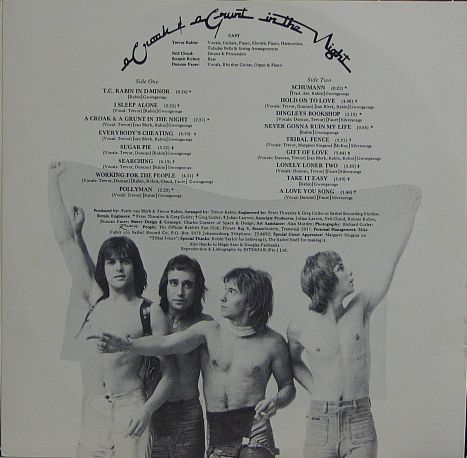
one which will stand up to repeated listening and also critical appraisal. But let's start strictly on face value with that infamous cover which continues to enthrall Trevor's fans over thirty years later, designed - as was Boys Will Be Boys! - by Patric van Blerk's former partner Charles Coetzee, and all the boys are nude (but not naked, there is a difference), by turns seductive and coy...at least until we get to Ronnie on the back cover, which is ultimately meant to poke fun at the concept, I'm thinking. However the international version of the album did not include the gatefold or the inner sleeve with additional photographs and lyrics so therefore the best version of the vinyl for collectors to obtain is the original South African release. The RetroFresh CD also contains all the applicable artwork. But beyond the obvious sexuality of the cover concept it's a slick and shiny package, right down to the label on the vinyl which is specially printed with an action pose of the band, proclaiming this is their record entire:
The album's sides are divided up in regards to vocal duties as Rabbitt possessed two singers. Side One is dominated by Trevor's lead vocals, whereas Side Two is mostly devoted to Duncan with the exception of two tracks, plus three instrumentals.
The album opens with two tracks which are wholly Trevor's in regards to both composition and ambition: the classical-transposed-for-electric guitar "T.C. Rabin in D-Minor" and "I Sleep Alone," a ballad which displays moody chromatics with an orchestral backdrop and the chiming of tubular bells, featuring Trevor's two voices: intricate classical-style guitar and his lush tenor supporting lovelorn (and more adult-minded) lyrics. This choice of sequencing illustrates the overall serious tone the production team meant to convey, that the album did not have to begin with a hit single, but rather build from a more naturally dramatic introduction.
From there it slides into the pocket with the title track, a slinky playful R&B-flavored wink and a nod to salacious activities, again another indication that the former boys had now become men and were looking to express themselves beyond the sweetness of pop into something more sophisticated. The accent of strings as a melodic refrain are a hallmark of Trevor's sensibilities as an arranger, appreciating the emotional resonance a good string section can offer, whatever mood may be required. As Doug Gordon points out: Trevor was as clever by then with string arrangements as Keith Richards was with guitar riffs, and he’s built his career on that understanding ever since.
This is followed by "Everybody's Cheating" - which was later covered by Rick Springfield on his album Beautiful Feelings - and although poignant there's a bit of dramatic irony displayed in such a passionate statement of devotion which then moves into a cynical refrain. I am thankful for a document of those days when Trevor could effortlessly hit the high notes - as he does when he sings and I believe I love you till my life is done - and the arrangement of stacked harmonies and buildup which then drops out at the end to just his voice and piano is gorgeous.
These songs are yet another reminder of how well Trevor and Patric van Blerk collaborated as songwriters, their body of work a perfect marriage of lyric and melody.
"Sugar Pie" is probably the first-ever example of Trevor composing a "fake out" (see: "Owner of a Lonely Heart") in that the introduction is completely different to the body of the song, so his orchestral sensibilities are evident in its prog-type overture, which then segues into more of a glam-like song. The call-and-response of Trevor and Duncan's vocals on the bridge and refrain emphasizes the contrast between their voices and is another great arrangement choice which became - even for as short a time as it was - a very definable element of their overall sound.
"Searching" is another big ballad with an anthemic chorus, and it's one of my favorites for reasons of personal taste. Primarily because Trevor sings in a way which was a specific stylistic choice but also, by 1979 his register would undergo a complete change: dropping down and developing a bit more grit, and so it's a wonderful snapshot of a bygone era: sensuous and breathy and wholly romantic. I wonder why those fans who are often expressing their love of Trevor's vocals don't mention the Rabbitt albums so much, because in my estimation his mid-70s range is the one which engenders that swoon-y devotion which long-time fans possess. Lyrically, the song offers a bit of an insight into the "mad years" as Trevor has described them: Now I don't mind the way things are. Wake up in the evening, breakfast in the bar.
Which he then counters with but somehow this just can't go on forever and it seems to me he has always practiced a certain prescience in regards to his own situation.
The last two songs are a pair which address the concerns of social justice, but in such a way that it's not wholly overt. To challenge the government would have brought a host of penalties and so one had to be clever. "Working For The People" is credited to the entire band with a co-lead vocal by Trevor and Duncan and was inspired by the Soweto riots of 1976, even as it seems to be merely about the struggles of a young band trying to make it big. It's a call for unity, because the "people" of which they sing is every member of the South African population, not merely the white hegemony who were the target of those riots. It's an anthem which blends a number of production elements (and also includes string accents rubbing shoulders with distorted guitars) meant to be chanted along to when one heard it on the radio or in live performance. There's even a bit of humor as the na-na-na refrain just sort of falls apart at the end.
"Pollyman" is, in my estimation, a mix of social satire with a metaphorical description of how the philosophy of apartheid literally warped the minds of those who adopted it. The music is purposely genteel and nostalgic - down to the creak of a rocking chair out on the proverbial veranda - while Trevor sings of a man who struggles with his own conscience (but also taking a moment to tease his bass player who apparently did not rise before noon): But now we see such an academic mind being programmed to their game. A jigsaw puzzle where the pieces don't fit, we'll jam them all the same. Where the big ones all can gain -
This is - especially the second line - a perfect description of the cognitive dissonance of apartheid as a social system. South African society was being supported literally upon the backs of its oppressed peoples, and Trevor lends his own voice to the appeal for humanity. In the fade out we hear conversation mixed in with the sound of a radio broadcast diatribe, which appears to be Trevor (who I believe has a little-known talent for impersonation). But this wasn't the first time he had addressed the subject, "Savage" from Boys Will Be Boys! is also about the injustices of apartheid, but again written in such a way as to be interpreted on several levels.
Side Two begins with "Schumann" which I believe is an arrangement for guitar of the opening theme of "Kinderszenen" by German composer Robert Schumann. Granted, it is just a fragment, and anyone in possession of the correct attribution please email me at the address in my introduction banner and let me know. But this illustrates both Trevor's classical training and his desire to maintain such forms even in a rock n'roll setting, which he would further elaborate upon throughout his career.
"Hold On To Love" is full of space and gauzy diffused layers of vocals and instrumentation, creating an overall mood of romantic longing, yet another great collaboration of Trevor and Patric. The chorus is just a simple refrain (and I can imagine thousands of girls singing along with it) but perhaps the best part is the pure rock n'roll scream Duncan lets out at the end just before the fade out. Ronnie also stands out on this song, his bass line providing an anchor amid the delicacy.
Ever a band to take advantage of cross-promotional
opportunities, Duncan has his moment in the greater media spotlight as the
composer of the theme song for the SABC sitcom Dingley’s Bookshop. Just as "Charlie" was included in the first film Trevor was to score the previous year, Death of a Snowman, this was another
chance for Rabbitt to be ubiquitous in SA popular culture and the boys mimed to
comedic affect in the opening sequence amongst the denizens of a certain
bookseller in Pietermaritzburg. The
track itself is probably the most obvious nod to Duncan’s primary influence, the Beatles, as a spritely piano-driven melody is augmented with whimsy:
staccato bursts of guitar, sound effects, and high harmonies on the refrain in addition to Duncan's Lennonesque vocal. The band also appeared - as themselves - in an episode of the show, prompting Trevor to dub himself and his bandmates "the world's worst actors."
Cross-promotional opportunities: Rabbitt appearing in the opening
credits (and performing the theme song) of Dingley’s Bookshop.
The second of the Side Two instrumentals is "Never Gonna Ruin My Life" and it's a little slice of the way Trevor liked to pair guitar with violin, set to Neil's rock-solid 4/4 beat. Throughout the album it's obvious that the band is thoroughly focused on delivering their best performances, but they also seem equally effortless in the way in which they mesh and meld; given that Trevor, Neil and Ronnie had spent nearly the greater part of their lives up to that point playing together.
If there was ever a declarative of the social conscience of the members of Rabbitt, it is displayed in their decision to cover the song "Tribal Fence" written by Ramsay MacKay, once the creative lynchpin of Freedom's Children. Croak was mixed in part by yet another member of that band, Julian Laxton (who would also go on to have a career as a solo artist as well as a producer), and as long-time fans know, Trevor and Ronnie were also members for a year, though by then that version contained only one original member. Freedom's Children was one of the first anti-apartheid rock bands in South Africa, continually flouting the establishment, and in that spirit - on record - Rabbitt also decided to cross the color line and record the song as a collaboration with Margaret Singana, one of the most popular black vocalists in the country on both sides of the charts. Trevor and Patric were the vehicle of her Top 40 career, providing co-production/arranging/songwriting/performance support on a series of albums for Jo'Burg Records (which were distributed internationally by Casablanca). Her fans called her Lady Africa and her powerful voice rises up like an charging army to ask when we will be/past tribal fence/and family tree. Singana also covered the song as the title track of her 1977 release. Trevor's arrangement of the song is more akin to free jazz than the heavy psychedelica of the original. But make no mistake: this was an incredibly audacious move on their part - the biggest band in the country and number one teen idols bringing a taste of revolution into every white household: moderate, liberal and conservative.
"Gift Of Love" evokes a spacy airy mood with layers of guitars, synths and electric piano surrounding Duncan for his turn in the spotlight as the object of fantasy which these songs were meant to evoke. The way in which Duncan and Trevor harmonize on the refrain is simply dreamy...and sure, you can say I'm biased but there's no better word for it. This is followed by "Lonely Loner Two" and it starts out with another bit of humor - as Trevor's count-off is interrupted by a belch from Ronnie - and is another mid-tempo Beatlesque excursion which would come to define Duncan's songwriting style on the subsequent album written and recorded without Trevor, Rock Rabbitt.
"Take It Easy," likely named for the aforementioned club where Rabbitt built their core audience before conquering the country entire, displays interesting elements of classical and progressive rock in its three minutes, as well as some fleet-fingered guitar heroics from Trevor.
"A Love You Song" concludes Side Two and is a sweet tribute to the wild ride entire, with Duncan commenting on how amazing it is to make music which has touched the lives of so many people. It is recorded in such a way that it sounds like he's playing in a club at the end of the night, after the crowd has departed, with a guitar voicing harmonizing with the piano. But in hindsight there is a bittersweet quality to it even as it celebrates a dream come true. It is, however, the perfect ending for the album: a moment of reflection and gratitude.
Trevor and Duncan both thought well enough of this album that they would later cover themselves: Duncan performing "Working For The People" during his stint with The Rollers (it would appear on their album Voxx), and Trevor would redo "Hold On To Love" as "Hold On To Me" for Can't Look Away with revised lyrics and Duncan providing backing vocals once more. Croak would go on to win a Sarie - as did Boys Will Be Boys! the previous year - for Best Contemporary Pop Album, capping off its nationwide success both critical and popular. But although all looked rosy for the boys' future, the center could not hold. As we see in this clip, which surfaced a few years ago (from what appears to be a documentary), the deal the band inked with Capricorn Records - one of the first mainstream independent record labels - for worldwide distribution and touring support fell apart before it was even fully realized, the result of both international censure and internal struggles.
The band had been courted by Frank Fenter, who possessed a unique understanding of the need for Rabbitt to break worldwide, as Candice Dyer writes in her 2010 article, "Frank Fenter: The Wizard Who Might Have Saved Capricorn:"
He understood how it (segregation) ultimately impoverishes everyone, including the oppressors, because he grew up in a place that was even more violently stratified than this cotton-belt town: South Africa in the darkest days of apartheid. He also knew — from sneaking into blacks-only nightclubs and presenting, like some ghostly apparition, the only white face around a drum-circled bonfire on the ragged outskirts of Johannesburg — about the unifying power of music.
Even as their future was planned as a collective, each member was also enticed to sign solo deals, and Trevor was the first to decide to walk away, though he would not officially emigrate to London until a year later. The remaining members attempted to carry on, and while Rock Rabbitt is a sophisticated collection of pop-rock, it is lacking Trevor's touch, and fans knew it too. Having to compete with Trevor's solo debut, Beginnings, meant a war for the hearts and loyalties of the fans they had won together. Trevor commented during my interview with him that the split was akin to a divorce, given the heightened emotions involved at that time.
But even with the brief bright promise displayed to a nation of devotees, and those elsewhere willing to adopt the band as their own (they developed a following in Japan through press coverage and record sales, for example), Croak is a record which can forever stand as a benchmark in Trevor's discography; an example of how Rabbitt was so successful all those years ago, and why a good portion of Trevor's fanbase hails from one particular spot on the map, proud that he is one of their special sons. Though it's true that no one can dictate the tastes of any of Trevor's fans I will say that if you are a fan and you do not have this record (or you only bought it for the cover), you should do yourself a favor and experience yet another reason to be amazed by the Maestro, because those abilities and instincts and that intelligence and charisma which would finally win him worldwide recognition, a decade later, was entirely apparent in his work with Rabbitt and especially on this, their very best album.