-->

Introduction:


A series of essays wherein I explore the numerous musical identities of my favorite musician: from child prodigy to teen idol to guitar hero to singer/songwriter to award-winning in-demand film composer.
Featuring news/updates and commentary/analysis of Trevor's career and associated projects.
Comments are disabled but please feel free to contact me at rabinesque.blog@gmail.com.


Wednesday, October 31, 2012

Halloween special: (slightly) scary subjects


 "English history has always fascinated me: Robin Hood, Cromwell...Jack the Ripper."
-Katherine Hepburn as Tracy Lord, The Philadelphia Story (1940)


The unofficial video for "She's Easy" produced by the BBC's The Old Grey Whistle Test, aired 2/14/81.

It's an interesting consideration that when newlyweds Trevor and Shelley moved to London in 1979, the milieu seemed to almost immediately influence Trevor's songwriting.  When I interviewed Trevor via phone in July, he related to me how the city produced the greatest cultural shock he'd ever experienced - coming from the oft-horrific cloistered social experiment which was South Africa - and although he was pressured to write songs which were au courant in regards to his new residence, as he was not a son of Albion he felt he couldn't relate to what was going on in the country at the time; from a political standpoint at the very least.  But both Face To Face and Wolf came to be peppered with British references which reflected the ways in which he was trying to fit into his adopted home.

But my true focus in this essay is a tip of the (witches) hat to the moments in which Trevor took a walk on the spooky side back in the London era.  The first is the song "The Ripper" on Face To Face, the lyrics of which appear to combine references of two true crime figures: Jack the Ripper and Peter Sutcliffe, who became known as the Yorkshire Ripper, in the final throes of his serial killer career around the time the song was composed and recorded (Sutcliffe would be finally apprehended in 1981).  The lyrics were composed by Trevor's then-manager Pete Smith (who also wrote the lyrics for "The Wanderer"), and the music is rather a sprightly tune with a memorable piano motif which does not really invoke a sense of dread in the evocation of the story, but rather focuses on how such a figure can remain a mystery even after attaining infamy.  But to my reckoning it - much like the reference to Yorkshire in "Candy's Bar" and the portrayal of London (though not specifically named) in "Now" - was a way of acknowledging Trevor was now planted in British soil, hoping to take root on his own terms.

But a more academic interpretation is offered in Chapter Two of Jane Caputi's feminist academic study The Age of Sex Crime (University of Wisconsin Press, 1987).  In "The Ripper Repetitions," she notes the song as part of a tradition (even in rock n'roll) which recounts and mythologizes the acts of a now notorious murderer; and its chilling quality comes from the first-person narrative of the lyrics themselves:
Rats, they'll call me just The Ripper
and George would love to know my name.
Fast, but man you know I'm quicker
I'll rid the world of all that shame.

The "George" which the song refers to is West Yorkshire Police Assistant Chief Constable George Oldfield, nominally in charge of the Yorkshire Ripper investigation.

The second track which I will next expound upon is rather more dread-full, though according to Trevor it was actually written as a joke of sorts.  And it appears on an album which does have a rather frightening cover by early-1980s standards:


Wolf, Chrysalis Records 1981

Taking the piss or no, the lyrics of "She's Easy" do reference a frightening figure of lore: that of the succubus. Because I believe this is not merely the tale of an nymphomaniac...but one who displays seemingly supernatural abilities.
Oooh yeah she goes down on you and she don't come up for air.
Oooh yeah she takes pride in love, it's a little much to bear.

In my estimation, this is a particularly telling couplet:
More than a woman, born out of a dream.
She takes you further than you've ever seen.
...because in various mythologies and literature the succubus is a malevolent force which may appear to men in their dreams for the purposes of sexual congress...which then leads to the male becoming sick or dying.
No resistance, you can do what you like
but you feel like a man, feels more like you died.
Think it's over, settle the score
then you turn your back, but she still wants some more.

Despite what can be construed as the cheesiness of the lyrics, the music is one of Trevor's strongest rock tracks: a great hook and chorus and a masterful long instrumental section, one of the standout guitar solos (along with "Heard You Cry Wolf" and "Looking For A Lady (Wolfman)") on the album.  The riff itself is a bit dark, which in turn fits the somewhat menacing tone of the lyrics, although I believe they are purposely ambiguous in regards to the portrayal of the female in question.  As the character who relates the allure of the subject, the emotional impact of Trevor's vocal comes across as more fearful than aroused.

The BBC2 musical variety television program The Old Grey Whistle Test chose "She's Easy" as a song to set to vintage film stock (as was their tradition with various new discoveries since the show's inception) and they used a short featuring puppets engaging in a romantic assignation (which turns into a comedy of errors when another man intrudes upon their interlude).  I have wondered for many years if perhaps the use of a Hammer Horror like The Vampire Lovers wouldn't have been more appropriate, but probably difficult in regards to obtaining clearance.  It was aired on their Valentine's Day broadcast in 1981, and is a rather twisted valentine at that when you consider what the song may truly be portraying.

Trevor would go on to score the horror film Exorcist: The Beginning (taking over for Christopher Young, who was the composer on the film when it was helmed by Paul Schrader) as well as various action thrillers like Deep Blue Sea and Snakes On A Plane, so Trevor's capacity for entertaining the eldritch continues to haunt him!

(This is where I would insert a creepy evil laugh, so let's just imagine I did.  And now I bid you loyal readers adieu...be safe, sane and spooky, mwahahaha!)

Wednesday, September 12, 2012

Rumor Control (and the lack thereof)

My readership has likely been tsk-tsk'ing me for not realizing that Trevor had originally revealed his tuba-playing aspirations via Facebook a couple months before I attended his recent public appearance and I fully admit I totally missed that part of his post (wherein he shared a couple of his favorite YouTube videos) from June 20th.  And so now we have to hold him to his promise of heavy metal on the next album. :op

(To sum up: me = fallible.  I'm so glad we sorted that out.)

A better example of being entirely fallible comes courtesy of two articles which I was rather irked by this month.  The articles are what I refer to as "secondary-sourced" in that they are merely restatings of other articles, both of which are interviews: one with Trevor and one with Jon Anderson.

Both take statements completely out of context resulting in misreporting (and as this is the Internet, that kind of thing can go viral in a matter of hours or days).  And these items are what I consider to be "political" concerns because they invoke the spectre of Yes, an endeavor which in the past has been challenging, one might say, in regards to its collective operation.

An ongoing debate in fandom has been the continuation of the band despite the absence of Anderson, one of its founding members.  It's happened before but now there seems to be rather a finality to its occurrence.  It's not my aim to debate the issue, however one of the writers at PROG took it upon himself to use Trevor to advance the "No Jon, No Yes" viewpoint in this recap of an interview on Blogdegezou:
http://www.progrockmag.com/news/trevor-rabin-you-cant-have-yes-without-jon-anderson/
What you may notice, however, is nowhere does Trevor actually state any of what the writer would have you believe in regards to the current status of Yes or the legitimacy thereof.  Ever the diplomat, Trevor did not take one side or the other in regards to the question posed to him by Henry Potts.  And so I wonder why Martin Kielty sees fit to drag Trevor into the middle of the ongoing argument when it's blatant misrepresentation and therefore bad journalism.

As for the other item, I have my opinion concerning the collective which - despite never having actually collaborated as of yet - is known as AWR - and I'll refrain from stating it save that I believe the hype and expectations which have been piled onto this idea since it was first brought up by Rick Wakeman in 2010 are altogether ridiculous.

The article which does something equally as bad is courtesy of Something Else!, a website which featured an interview with Trevor a couple months back.  Last week Jon Anderson gave an interview to CBS affiliate WZLK and the website posted a recap which also took his comments about the status of AWR entirely out of context, causing fans to believe the project is in the works now, and that is simply not true.
http://somethingelsereviews.com/2012/09/08/recording-as-we-speak-new-album-in-works-from-yes-alums-jon-anderson-rick-wakeman-and-trevor-rabin/
I believe interviewers should cease inquiring as to the status of the project because how many times can one hear the same answer?  Or answers which are speculative and not actual.  What is the use of that?  Granted, a collaboration between Trevor, Rick and Jon would be wonderful, and something I would love to hear.  But it until it actually happens I don't plan to waste any time pining for it, nor would I (or did I) ask about it.

Instead, I'll be enjoying the music Trevor is making now, and in the (definitely foreseeable) future...especially if it involves the tuba.

Monday, August 20, 2012

The legend of TrevRa and other anecdotes

Sometimes familiarity can make it difficult to know when to take someone seriously.

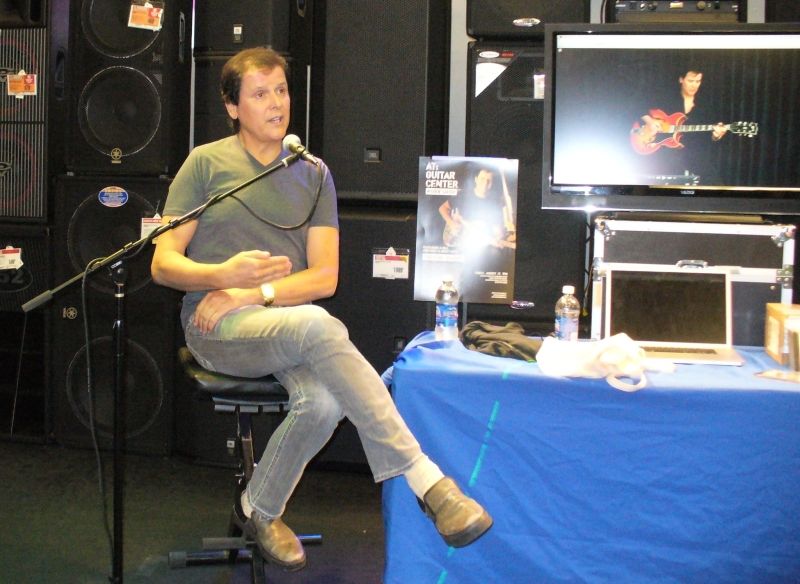
Trevor is known for his mischievous sense of humor, which manifests itself in many things - from songs to comments to pranks - and so when he stated during his August 17th Q&A at the Guitar Center in Sherman Oaks that he was learning to play the tuba, well...truly, my first thought was Pull the other one, Trev!  After all, this is the man who allowed people to believe he possessed multiple spleens for decades, chuckling all the while, I'm sure.  But you read it here first (unless, of course, you were at the event): we might be treated to a thundering tuba interlude on Trevor's next solo record.  Unless he lets us in on the joke years from now and then I can declare Ah I knew he was just messing with us!  But to watch him explain (and make appropriately comical grimaces) how awkward it is to hold a tuba  - how heavy and how cramped one feels with it on the torso - was totally hilarious, as were his impressions regarding the different positions one can utilize in order to play a guitar.

Trevor also revealed during the course of discussion that he will be scoring the entire first season of the upcoming ABC series Zero Hour, which marks a new chapter in his scoring career and yet another reason for Rabinites to stay glued to their televisions (although I'm still confused as to whether the show is on the Fall schedule or is a midseason replacement, as there are conflicting sources of information).

A nice surprise for me was to hear Trevor recite some of the lyrics from "(Wake Up!) State Of Fear," a song which has taken on the feel of a folk tale because the version he recorded with Freedom's Children was never released and thus has never been heard save by those who had seen that particular lineup perform it.  But it was a great example of how much he desired to address the problems facing South Africa at that time, when protest against Apartheid was usually squelched quickly and violently, and the song ended up becoming a casualty of the government's draconian censorship policies.

The audience was allowed to ask questions at the end of the session and I was the last of those participants.  I came up to where Trevor was sitting because in order to ask my question - about his famous Strat - I needed to reference his new portrait shot, which was displayed in the promotional poster for the event on the table next to him.  I recently obtained a hi-res copy of that photograph which allowed me to closely examine the Strat and I noticed something I'd never seen before in any of the photographs and screencaps I have of the guitar, and I was curious about what it was.

I started out by teasing him: "You know, it's not as if we don't know whose guitar this is, because your initials are all over it!"  And he said, "Yeah I hate that," which surprised me, given that he's done the same to his favorite Alvarez, which was his main axe for many years.  But also because he carved his initials into the body at the lower end many years ago.

Much love to Larry Mah for this wonderful photo.

Trevor noted that his son Ryan's name is on the guitar as well (there is a Ryan sticker on the scratch plate, which was added circa 1988, I like how he placed it so he could read it whenever he played the guitar):

The Ryan sticker when it was (relatively) new, from 1992.

...which is known to fans, of course, and so I asked for the story behind it and he replied, "I found this dynamite sticker and he's my dynamite boy!"

(Best.  Dad.  EVER!)

The Ryan sticker is a bit faded by time now but still legible:


But what I wanted to ask about was this, on the upper part of the body:


I stated that I had just noticed it thanks to being able to examine a hi-res version of the photo and asked what it was.  Trevor explained it was a pin - a lapel pin, I'm assuming - from Chrysalis used to promote Trevor Rabin (the 1979 international release of his first solo album).  I also asked and he noted it was broken because not all of his name is there now.  It does feature the same typography as on the album cover itself:

Trevor and I agree this is his worst album cover ever.

As I returned to my seat Trevor declared, "Great question!" which was very kind of him.  Driven by a need to know things...that's me!  And it's finding things out which is the greater reward.

Saturday, August 18, 2012

Meeting the Maestro

I've met some tall musicians in my time...the late Peter Steele of Type O Negative (6'7) and Danny Carey of Tool (6'5) just to name two.  And my favorite musician resides in that rarefied air as well (6'3) but even knowing someone is tall, it's still a surprise when you actually see them in person.  Or at least it is for me.

The promotional juggernaut for Jacaranda has offered fans a nearly unprecedented amount of media coverage - Trevor hasn't done this much press since his days in Yes - and it's been wonderful, but his personal appearance at the Guitar Center location in Sherman Oaks on August 17th (as part of Trevor's promotional partnership with the musical instrument retail chain enacted this year) was certainly a boon for SoCal fans (like myself).  Other than movie premieres, Trevor has not made a public appearance of this type since the Varese Sarabande signing at Dark Delicacies back in 2003.

And so in true fangirl fashion I braved the heat (we've been having high temps and high humidity here in Southern California this week as it's monsoon season) and traveled far north (for me) to the Valley to attend this event.  And when I say "high" I mean it: it was 104 in the afternoon when I first arrived!  It turned out to be a rather intimate event in that there were only about 15-20 people all told.  Others I was very happy to meet included Trevor's wife Shelley (who was kind enough to lend us Trevor on the night of their 33rd wedding anniversary), Alex May (who works for Trevor's publicist firm Costa Communications), Elyse Glickman (a journalist and fan who credits her 1989 interview with Trevor in launching a writing career that now spans 20+ years and many subject areas), and Lee Gately, the founder of the YesMuseum website, as well as various members of the Yesfans discussion forum of which I am also a member.

This was my third time chatting with Trevor, the first being back in 2009 (and out of that experience this blog was born, but that's another story) and the second time was just three weeks ago, we had an hour-long phone conversation which was a lot of fun for me and he graciously agreed with that assessment.  I believe this event was an even better in-store experience than just a CD signing because the attendees had the chance to listen to Trevor expound on various topics, as the employee who acted as host led the audience through Trevor's musical history with questions and comments.  Trevor's Q&A (which lasted about 60-90 minutes) was then followed by a period of time wherein he graciously signed items (one guy brought two beautiful guitars - a Strat and a Les Paul - for Trevor to sign) and posed for photos.  Before the event I had a chance to introduce myself and he fondly recalled our interview but interestingly he immediately noticed that I was wearing a replica of the necklace he used to wear in the early 90s, with a Sharkfin plectrum charm and a number 13 charm.  I also have a small garnet heart charm on mine which I told him represents the heart tattoo he has on his left breastbone.  After he posed for a photo with me Trevor joked, "I should have worn mine and we could have matched!"

Trevor was also kind enough to allow the audience to preview his new video for "Rescue" and so as not to spoil it too much I'll just note that it features the lovely and talented Liz Constantine, whom of course reprises her original vocal from "Rescuing Fischer" on the track.

Mr. Rabin submits to our inquisition.

Friday, August 3, 2012

Fashion Watch (oh, and The Video!)

Those readers familiar with my fandom discussions know of my running joke regarding The Maestro's wardrobe...long-time fans can spot familiar items of clothing in almost any photo existent (sometimes even Ryan has worn Trevor's clothes) and a brand-new opportunity for further Trevspotting presents itself in the long-awaited appearance of Trevor's directorial debut, the music video for "Anerley Road."

Eh voila!

It certainly felt like a long time coming...fans were given a glimpse during Trevor's appearance on The Weekly Comet online talk show and the lucky attendees of Trevor's release party for Jacaranda at the Gibson Museum on June sixth were treated to a full preview.

And so I must exclaim with unbridled glee over the kickin' plaid pants and the shorts (!) as well as those items from Trevor's closet we've seen before.  Although I have to admit it sort of reminded me of that one commercial for luncheon meat in which a harried wife is dealing with her husband's midlife crisis and his yearning to wear skinny jeans.

The video also features stills of the lovely and talented Tal Wilkenfeld, Lou Molino looking like a classic jazzbo in a natty buttondown-and-tie ensemble, all nine guitars (and dobro) used in the song, and a cast of whimsical statuary from the expensively eclectic Regalo boutique featured in the studio decor.  My rhetorical question to the auteur (but more Robert Rodriguez than Alfred Hitchcock): What, was it not Casual Friday at The Jacaranda Room?  There's quite a wealth of detail to be found for the observant viewer; with many shots showing more of Trevor's studio than we've seen previous; like the huge collection of awards next to the piano (too many to fit on top now, the weight will make it go out of tune!).

Trevor's sense of humor is wholly evident in this effort, and it's the little things: like the blink-and-you'll-miss-them jump cuts during Lou's shots (which feature an image of Trevor in a totally cheesy Hollywood pose).  There are other jump cuts included, although not quite as humorous.

Although it was likely unintentional, there's a little homage to Trevor's previous video for "Something To Hold On To" (a wacky collision of director Jeff Stein's 80s-era eye-popping aesthetic and Trevor's sense of humor): a shot in which Trevor is seen in real time playing in the foreground, while in the background the projected image of himself on the studio's widescreen monitor provides accompaniment - recalling shots in the former video where Trevor plays along with himself as seen on a bigscreen TV in his house of guitars (reportedly the home of actress Shelley Duvall, who also appears in the video...well, her eyes do, that is).


I like the closing shots the best: a couple stills of the street Trevor grew up on in Parktown, I appreciate the little glimpse into the past he has given us.

Now that The Maestro has stated he wants to shoot a video for every song on the album, we can all have fun speculating on which song will be next.  My vote goes to "Me and My Boy," which would be fabulous cutting back-and-forth from a photo montage of Rabin & Rabin through the years with sequences of the two of them tearing it up in the studio...especially with one particular photo I know of which shows the proud papa giving his infant son his first lesson in engineering at the console in The Jacaranda Room (on a decidedly casual day, given Dad's attire!).  But a true auteur has to find his own path to fulfillment...which is why we're so lucky to have Jacaranda as part of the soundtrack to our lives.

Thursday, July 12, 2012

Five from five

As this year marks the release of Trevor's fifth solo album (I find it interesting that he and Peter Gabriel have solo careers of similar length and gaps between latter-day releases and yet Trevor still beats The Gabe in regards to fewer solo albums in the same timeframe, but more film scores), I thought I'd offer up a list of what I consider to be the best track from each record, hence the title of this entry.

And no, I don't count Beginnings and Trevor Rabin as two separate releases despite the fact that they are, physically, two different albums.  I consider the latter as the former's calculating doppelganger, unfortunately even those efforts to make it internationally palatable did not succeed in the way in which the album deserved to.

"Live A Bit"
Beginnings (1978)
Beginnings (and its eponymous doppelganger) is my favorite of the vocal solo albums because I believe - for all its naivete - nothing comes closer to the true expression of Trevor's range and ambition and emotion in regards to his own music.  In this I am likely alone amongst Rabinites but I say to them: you're missing out by ignoring this record.  For one thing, it's romantic in ways in which his later material would not be, and one of those ways is illustrated in this song...there's a dreamy, brooding, almost hallucinogenic quality about both the lyrics and the music which is singularly beautiful and compelling.  Trevor's Strat wails and moans and swoops across an almost menacing shuffle of bass and drums, with the tension of orchestral strings hovering above it all.  Lyrically, in a metaphorically oblique fashion, I believe it addresses the strange quality of freedom he was experiencing in going it alone, creatively, and this is supported by his observation that the only thing that's permanent is change.  But the repeated refrain is a joyful cry of relief, to emerge from the other side of sudden fame and the enormous weight of adulation and scrutiny and find himself to be still whole and (mostly) sane; as is the end solo, reminding one and all - though he's no longer a Rabbitt - Trevor is still a musical force to be reckoned with.

"Now"
Face To Face (1979)
Trevor's earlier records tend to be given short shrift by fans and I do confess to a certain disappointment in regards to Face To Face, my least favorite, in which I believe Trevor is trying too hard to fit into the box desired by Chrysalis A&R in regards to his musical identity.  The album has a decidedly UK focus in regards to the subjects and references in the songs and that is evident on my choice for strongest track which opens Side Two; it is ambitious, dramatic and inventive in regards to its rendering of a stranger trying to survive in the cold cruel city.  It also contains a rhyme which never fails to make me smile at its cleverness:
I see Mad Jack still sleeps in the foyer
he's gotta get out, being sued by a lawyer
and it's backed throughout by percussive vocalizations (courtesy of Trevor and Rene Arnell) which are a direct precursor to the "acapella Disneyland" of "Leave It" as well as an interesting use of a Strat he borrowed from David Gilmour with hex-type pickups, resulting in a (in Trevor's words) "high shimmering effect that's really beautiful."

"Heard You Cry Wolf"
Wolf (1981)
I think of Wolf as an "imperfectly perfect" album, for reasons I won't expound on here, but I believe even Trevor considers this the best song of the pack, as it's the only one from the former years of his solo career which he included in the setlist when touring in 1989.  On an album containing delicious cheese ("She's Easy," "Long Island"), bluesy struts and shuffles ("Stop Turn," "Take Me To A Party") and rock-solid guitar heroics throughout, this is the song which best displays a number of Trevor's overall strengths: a strong hook, catchy chorus, dramatic arrangement, good lyrics which don't strain the metaphor overly much, and a long soaring solo in the rideout which is truly swoon-worthy (and gorgeously rendered live courtesy of a few bootleg recordings and the 2003 release Live In LA).

"I Can't Look Away"
Can't Look Away (1989)
The title track of sorts, this is the album's mission statement in that the emotion and ambition of this song colors the rest of the album entire, even those songs which stray from its aura of gravitas.  Addressing a subject near to his heart and mind as a son of Msanzi, the lyrics are poetically evocative and the arrangement shifts from quiet to loud, a textbook example of the Rabinesque sense of grandeur, to emphasize the nature of strife and the yearning for peace.  This is another song which is all the more passionate and powerful when performed live, and the showcase for some of Trevor's best guitar playing in his overall history as a performer.

"Anerley Road"
Jacaranda (2012)
On an album which is perfect it's tough to choose one piece of perfection over another.  This is likely a contentious choice for those readers who have been spinning/streaming the album and probably prefer "Through The Tunnel" which audaciously careens between peaceful passages and all-out sonic warfare, or "Me and My Boy," the metallic hoedown as delivered by Tremander.  However, for me nothing is as indicative of Trevor's mindset, memory and creative acumen as this wholly fusionesque offering named for the Parktown, Johannesburg street which contained his childhood home.  This strikes me as the lynchpin of the record in regards to its presentation of existing fusion tropes and how they can be manipulated, melded, and even inverted while still retaining the sonic definition thereof.  Bracketed on either end by a Barney Kessel-style coda, the multitude of textures (courtesy of nine different guitars plus dobro) create a fascinating wall of sound which is punctuated by the tasteful drumming of Lou Molino and a lengthy dialogue between Trevor and bass wunderkind Tal Wilkenfeld, whose solo midway through the song (during an interlude in which the mix lays back to let her shine) is a thing of evocative beauty.  The way the two voices (guitar and bass) entwine towards the end (featuring a part by Trevor on his custom Tobias which sounds a bit like an angry bumblebee) is playful and confident.  By the end of the track all previous stereotypes and preconceived notions regarding Trevor's abilities have been summarily ripped to shreds.  Class dismissed!

Tuesday, July 3, 2012

The Man of a Thousand Credits: dipping a toe in the Ocean(a)

One of a continuing series in regards to the myriad variety of Trevor’s discography.


Back in 2006 Trevor lent his talents to a project helmed by Don Harper, who has been a longtime colleague of Trevor's as a member of his scoring production team, and I consider the track he played on to be one of the great unsung classics of Trevor's career, a link between past and present, the way in which his film scoring sensibilities began influencing his writing overall, and the true breadth and depth of his playing.

It is one of those moments which again proves Trevor possesses the finest of jazz sensibilities in an era when many considered him merely the purveyor of pop hooks, guitar cliches and Music To Watch Explosions By.

But as usual, all those people are dead wrong.

Don't take my word for it, though...here are Don Harper's impressions:
"I came up with the idea to do an Americana piece that allowed him to interact with the orchestra and yet allow him the space to do his "Trevor" thing, really not knowing what I might expect. I sent him the orchestral tracks and let him go. When I listened to the tracks (and peeled myself off the back wall of my studio) I was actually shocked at the energy in the first movement and the sensitivity in the second. Understand, the project is not particularly commercial and eclectic to say the least, but the emotion of what Trevor played shocked and surprised me. Surprised because, I knew from working with him, what his rock and classical abilities were but I had no idea of the Jazz sensibilities he would bring to the composition. The back half starts off in a Kenny Burrell vibe and goes from there to...I have no idea. Who knew? I know I'm preaching to the choir, but I think he's just getting warmed up!" 
Warmed-up indeed...when we consider what was yet to come.

There are not enough adjectives to describe the absolute beauty of Trevor's playing on this piece, and as I am not one for piling them on just because, I'll leave you with this: those unfamiliar with this piece can now experience a bit of Trevor's creative mindset as he created Jacaranda, but in a somewhat different milieu in regards to the orchestral arrangement.  However, the combination is indeed inspired and something Trevor is not only well-versed in, but entirely sympathetic to.  He shows that he is capable of a variety of emotions: subtlety and restraint, passion and power, serene melodicism and fiery fretwork.

(Okay that was perhaps a bit much...but it's worth it to praise this piece of genius.)

I have many desires in regards to Trevor's instrumental output, and one of them is to hear an entire album of this kind of music, but even one track like it in future would be a beautiful thing.

from Don Harper's Oceana Orchestra's 2007 release Dream & Variations
"Where Do We Go From Here?" featuring Trevor Rabin